
Updated October 2026. App details checked against each app’s store listing or help page.
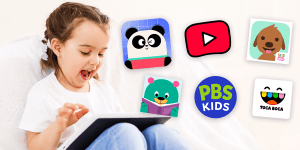
The best ad-free apps for kids in 2026 are Lingokids, Khan Academy Kids, PBS KIDS Games, Sago Mini World and Pok Pok. None of them show ads to children. Khan Academy Kids and PBS KIDS Games are completely free, Lingokids has a free plan, and Sago Mini World and Pok Pok are subscriptions. Toca Boca World has no third-party ads but sells extras inside the app, and YouTube Kids shows paid ads unless you pay for YouTube Premium.
If you’ve ever handed over a tablet and heard a loud ad for some random game two minutes later, you know why parents search for this. Ads break the fun, can show things you didn’t choose and push kids to tap “buy”. Below is a quick comparison, a short take on each app, and a checklist to test any app yourself in five minutes.
Ad-free apps for kids: quick comparison
| App | Cost | Ads for kids | Purchases inside the app | Ages |
|---|---|---|---|---|
| Lingokids | Free plan + Plus subscription | None, on any plan | Plus subscription (parent area) | 2 to 8 |
| Khan Academy Kids | Free | None | None | 2 to 8 |
| PBS KIDS Games | Free | None | None | 2 to 8 |
| Sago Mini World | Subscription (free trial) | None for subscribers | None for subscribers | 2 to 5 |
| Pok Pok | Subscription (free trial) | None | Subscription | 2 to 7 |
| Toca Boca World | Free download | No third-party ads | Yes, paid packs in the shop | Rated 4+ |
| YouTube Kids | Free | Yes, paid ads (removed with YouTube Premium) | No | Up to 12 |
The 7 apps, one by one
1. Lingokids
Games, songs, shows and stories with Billy, Lisa, Cowy and Elliot, all in one app for kids 2 to 8, in English, Spanish and Brazilian Portuguese. There are no ads on any plan. The free plan gives 10 activities a day; Plus unlocks 4,000+ activities, up to 4 profiles and offline play. Best for families who want variety: kids switch between a game, a song and an episode without leaving a safe space.
🎮 Play it in Lingokids: Bathroom Time. The most-played game in Lingokids: bubbles, brushing and splashing with Elliot and Lisa, and not a single ad.
2. Khan Academy Kids
Free, with no ads and no subscriptions, from the nonprofit Khan Academy. It leans more toward school-style activities (letters, numbers, reading) for ages 2 to 8. Great if you want a calm, structured option at zero cost.
3. PBS KIDS Games
Free, with no ads and no in-app purchases, featuring PBS KIDS characters. Hundreds of short games for ages 2 to 8. Perfect for kids who already love the shows.
4. Sago Mini World
Open-ended pretend play for the youngest (ages 2 to 5). It’s a subscription with a free trial; subscribers get no ads and no in-app purchases. Very gentle, very toddler-friendly.
5. Pok Pok
Calm, Montessori-inspired digital toys for ages 2 to 7. Subscription with a free trial and no ads. A good fit for kids who get overstimulated easily.
6. Toca Boca World (with a caveat)
Toca Boca says the app never shows third-party ads, which is great. But the free download comes with a shop of paid locations and packs, so expect “can I buy this?” moments. Set purchase restrictions on the device before handing it over.
7. YouTube Kids (not ad-free)
YouTube Kids is free but shows paid ads before videos, according to Google’s own help page. They’re reviewed as family-friendly and aren’t clickable, and YouTube Premium removes them. If ads are a dealbreaker, see our best alternatives to YouTube Kids and our Lingokids vs YouTube Kids comparison.
Why ads in kids’ apps are a problem
- They interrupt. A 3-year-old can’t tell a game from an ad, so they tap anywhere just to get back to playing.
- They show things you didn’t choose. Ad networks in free apps don’t always filter for little kids.
- They push buying. “Get coins”, “unlock now”, “download free”. Kids don’t understand money yet, so it turns into frustration and constant asking.
- They often come with tracking. Exactly what you don’t want in an app for young children.
How to check if an app is really ad-free (5-minute test)
- Read the store listing. Look for “no ads” and check the in-app purchases line. “No third-party ads” and “no in-app purchases” are two different promises.
- Play it yourself first. Five minutes as your kid would. Any pop-up, banner or “buy” button tells you what you need to know.
- Look for links out of the app. A safe app doesn’t send kids to a browser or store with one tap.
- Check the parent area. Subscriptions and settings should sit behind a parent gate, not in the kid’s path.
Lingokids: ad-free entertainment the whole family can trust
Lingokids is built so you can hand over the tablet and relax: no ads, no surprise links, no buying prompts in the kids’ area. What keeps kids coming back is the characters and the mix of games, songs and shows, not rewards or pop-ups. Want to see it for yourself? Start with the free plan.
FAQ
What are the best ad-free apps for kids?
Lingokids, Khan Academy Kids, PBS KIDS Games, Sago Mini World and Pok Pok don’t show ads to children. Khan Academy Kids and PBS KIDS Games are free, Lingokids has a free plan, and Sago Mini World and Pok Pok are subscriptions.
Is there a free kids app with no ads?
Yes. Khan Academy Kids and PBS KIDS Games are free with no ads and no in-app purchases, and Lingokids has a free plan with no ads.
Does YouTube Kids have ads?
Yes. YouTube Kids shows paid ads that Google reviews as family-friendly. A YouTube Premium subscription removes them.
Does Lingokids have ads?
No. Lingokids has no ads on any plan, including the free one. The paid Plus plan unlocks more activities, more profiles and offline play.